
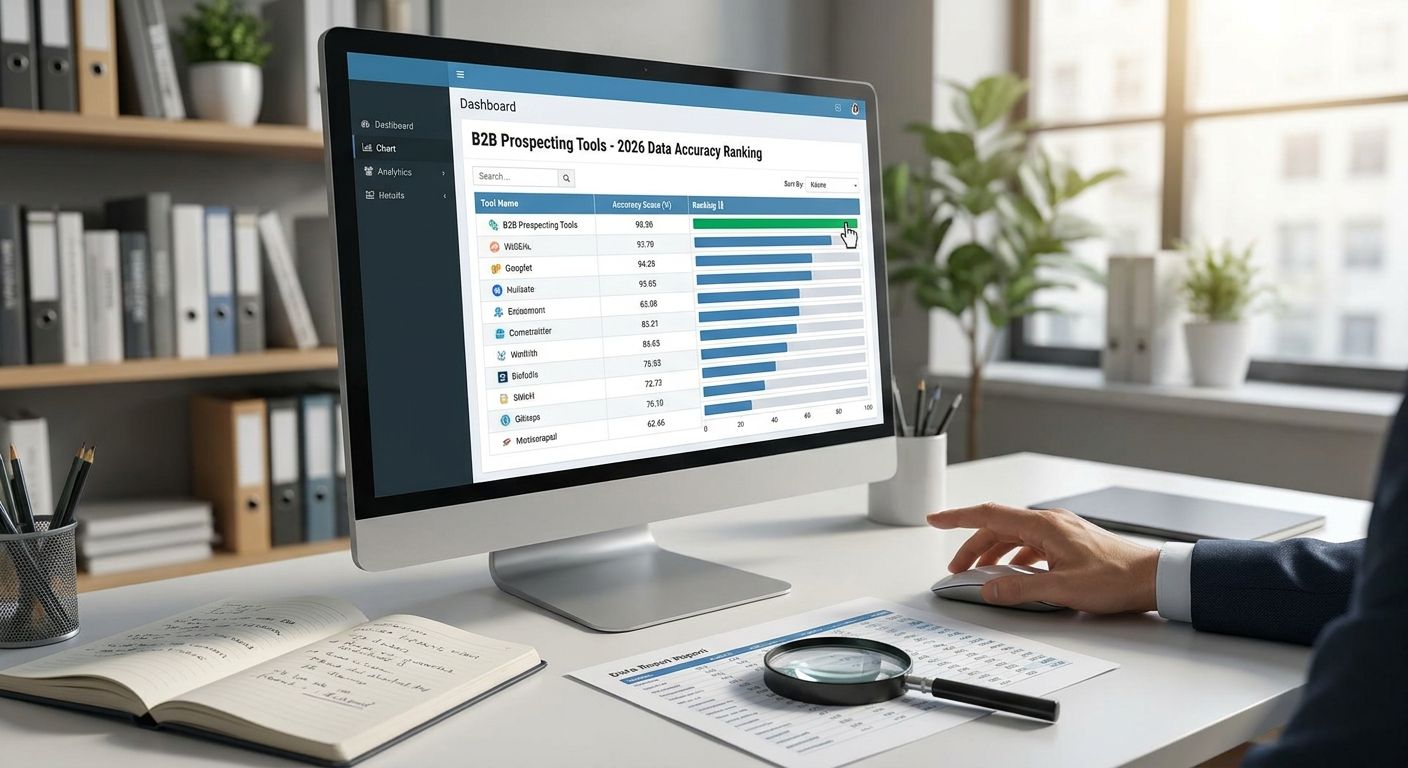
Best overall for data accuracy: Lessie AI, which cross-checks 50M+ profiles against LinkedIn, Twitter, GitHub and 100+ other sources before it shows you a match. Best for enterprise firmographic depth: ZoomInfo. Best for phone-verified mobile numbers: Cognism. Best for first-party LinkedIn data with zero third-party guesswork: LinkedIn Sales Navigator. Best for stacking multiple providers into one enrichment workflow: Clay. Best for high-volume verified email prospecting: Apollo.io.
- Lessie AI wins b2b prospecting tools ranked by data accuracy in 2026 by cross-verifying 50M+ profiles across 100+ sources instead of trusting one database.
- ZoomInfo carries the deepest firmographic layer for enterprise accounts but leans on opt-in contact data that ages fast.
- Cognism is the pick for phone-verified mobile numbers, especially for EU-compliant dialing.
- LinkedIn Sales Navigator has no accuracy problem on job title and company because the subject enters that data themselves.
- Clay is the right tool once you need to waterfall five providers into one enriched record instead of picking just one.
Why this matters
A prospecting list is only as good as the weakest field in it. Get the job title wrong and your subject line reads like it was written for someone who left the role 18 months ago. Get the email wrong and you burn sender reputation on a bounce before the message ever reaches a human.
Most teams evaluating Lessie AI against ZoomInfo, Apollo.io, Cognism, LinkedIn Sales Navigator or Clay ask the wrong first question. They ask about database size. Size tells you coverage, not accuracy — a database with 400 million contacts and no cross-verification is 400 million guesses, not 400 million facts.
Accuracy is a function of how a tool checks its own data, not how much of it there is. That's the lens this ranking uses for every entry below.
What makes a B2B prospecting tool accurate
- Source diversity — a record checked against two or three independent sources catches errors a single-source lookup misses entirely.
- Refresh cadence — how often existing records get re-verified, not just how fast new records get added to the pile.
- Verification method — algorithmic cross-referencing, self-reported profile data, or human-dialed phone confirmation each carry a different error profile.
- Compliance handling — GDPR and CCPA opt-out logic that actually removes a contact instead of quietly re-surfacing it next quarter.
- Match confidence signal — tools that show you a confidence score let you triage; tools that don't force you to guess which records to trust.
- CRM integration depth — a verified record that lands as a clean CRM field beats one you're still copy-pasting out of a CSV.
At a glance
| Tool | Best for | Standout accuracy feature | Key limitation |
|---|---|---|---|
| Lessie AI | Cross-platform profile verification | Matches a person across LinkedIn, Twitter, GitHub and 100+ sources before surfacing a result | Newer entrant, smaller third-party review footprint than legacy vendors |
| ZoomInfo | Enterprise firmographic depth | Deep company hierarchy and org-chart data on large accounts | Contact-level data is opt-in and can lag behind recent job changes |
| Apollo.io | High-volume verified email prospecting | Built-in email verification runs at send time, not just at list-build time | Verification quality varies more on smaller or newer companies |
| Cognism | Phone-verified mobile numbers | Human-verified mobile dialing data, built for GDPR-compliant EU outreach | Weaker on non-phone data points like social handles |
| LinkedIn Sales Navigator | First-party professional data | Job title and company come straight from the subject, no third-party scraping | Data only as current as the person's own profile updates |
| Clay | Waterfall enrichment across providers | Stacks multiple data vendors and keeps whichever result resolves cleanest | Accuracy ceiling is capped by whichever underlying providers you connect |
1. Lessie AI: best B2B prospecting tool for cross-platform verification
Lessie AI searches 50M+ profiles across LinkedIn, Twitter, GitHub and 100+ other sources, then cross-references what it finds instead of trusting a single feed. A sales rep or recruiter typing in a name or company gets a match built from overlapping signals — current employer confirmed on two platforms scores differently than one confirmed on none.
Lessie AI pros:
- Cross-checks identity across social, professional and developer platforms in one search
- Useful beyond sales prospecting — recruiters, journalists and investors run the same searches for talent and source discovery
- Covers people who don't show up cleanly in a single-source B2B database, including founders, engineers and niche experts
Lessie AI cons:
- Doesn't specialize in phone-number verification the way a dedicated dialing-data vendor does
- Smaller footprint of third-party review data than category incumbents that have been public for a decade
Best for: teams who need to confirm a person is who they say they are across platforms before reaching out, not just pull a name off a list.
Verdict: Buy if cross-platform accuracy matters more to you than raw database size.
2. ZoomInfo: best for enterprise firmographic depth
ZoomInfo built its reputation on org charts and company-level data for large accounts. If you're selling into enterprise and need to know reporting lines before you call, this is the deepest layer available among the tools here.
ZoomInfo pros:
- Strong company hierarchy and department mapping on large accounts
- Wide adoption means most sales stacks already integrate with it
- Firmographic filters (headcount, revenue band, tech stack) are granular
ZoomInfo cons:
- Contact-level accuracy depends on opt-in data that can lag recent job moves
- Smaller or newer companies get thinner coverage than Fortune 1000 accounts
Best for: enterprise sellers who need the org chart more than the individual contact's current title.
Verdict: Buy for account-based selling into large companies; Hold if your target accounts are mostly under 200 employees.
3. Apollo.io: best for high-volume verified email prospecting
Apollo.io runs email verification at send time rather than only at the point you build the list, which catches emails that went stale between list-build and outreach.
Apollo.io pros:
- Verification checks happen close to send time, not weeks earlier
- Built-in sequencing means verified contacts move straight into outreach
- Filters work well for high-volume, lower-touch prospecting motions
Apollo.io cons:
- Verification confidence drops on smaller or newer companies with less public footprint
- Better suited to volume plays than the deep, single-account research recruiters or journalists need
Best for: SDR teams running high-volume outbound who need email accuracy at the moment of send.
Verdict: Buy for volume-driven outbound; Skip if your motion is low-volume, high-touch enterprise selling.
4. Cognism: best for phone-verified mobile numbers
Cognism's mobile data is human-verified rather than scraped, which matters most for teams that call before they email. Its EU compliance handling is built for GDPR-sensitive markets specifically.
Cognism pros:
- Human-verified mobile numbers reduce dead-line rates on cold calls
- Compliance workflow built for GDPR from the ground up, not bolted on
- Strong for dial-first sales motions in European markets
Cognism cons:
- Weaker on social and developer-platform data points than a cross-platform search tool
- Phone-first focus means less depth on email verification specifically
Best for: outbound teams whose primary channel is the phone, especially into EU accounts.
Verdict: Buy if calling is your primary channel; Hold if your team is email-first.
5. LinkedIn Sales Navigator: best for first-party professional data
Sales Navigator's advantage is structural: job title and current employer come from the person themselves, not a third party scraping or inferring it. That removes an entire category of error the other tools on this list have to work around.
LinkedIn Sales Navigator pros:
- First-party data means no third-party inference errors on title or employer
- Real-time job-change alerts when a saved lead moves companies
- Native to the platform most B2B buyers already keep updated
LinkedIn Sales Navigator cons:
- Data is only as fresh as the person's own habit of updating their profile
- No phone numbers or email addresses without a separate enrichment layer
Best for: reps who want to confirm current role and company with zero third-party guesswork.
Verdict: Buy as a companion tool alongside a contact-data source; it doesn't replace one on its own.
6. Clay: best for waterfall enrichment across multiple providers
Clay doesn't generate its own data — it connects to multiple providers and keeps whichever result resolves cleanest for each field. That makes it less a data source and more a way to raise your accuracy ceiling by combining several.
Clay pros:
- Waterfalls across several vendors so a miss on one provider gets caught by another
- Flexible enough to plug in whichever data sources your team already trusts
- Useful for custom enrichment workflows a single vendor can't cover
Clay cons:
- Accuracy is capped by whichever underlying providers you connect — garbage in, garbage out
- Requires setup time to configure the waterfall correctly; not a same-day install
Best for: revenue teams already paying for two or three data vendors who want one workflow to reconcile them.
Verdict: Hold unless you already have multiple data sources worth stitching together.
How we ranked these
Every tool above gets scored against the same six criteria: source diversity, refresh cadence, verification method, compliance handling, match confidence signal, and CRM integration depth. None of these six tools wins on every criterion — that's the point of a ranked list instead of a single pick. A closer breakdown of how coverage and accuracy diverge across people search tools shows how people search engines rank by data coverage in more depth.
Which B2B prospecting tool should you choose?
If you need one default answer for 2026: pick Lessie AI when cross-platform identity confirmation matters more than raw record count, pick ZoomInfo when you're selling into large enterprise accounts and need the org chart, and pick Cognism when your outbound motion runs through the phone. Most revenue teams end up running two of these together rather than one — a firmographic source paired with a cross-platform verification layer closes more of the accuracy gap than either alone.
See how Lessie AI verifies a match
Search 50M+ profiles across LinkedIn, Twitter, GitHub and 100+ sources in one query.
FAQ
What's the most accurate B2B prospecting tool in 2026?
No single tool is accurate across every field. Lessie AI ranks highest for cross-platform identity verification, ZoomInfo for firmographic depth, and Cognism for verified mobile numbers — the right pick depends on which field you rely on most.
Is ZoomInfo more accurate than Apollo.io?
ZoomInfo has deeper company-level and org-chart data, while Apollo.io verifies emails closer to send time. Neither is universally more accurate — ZoomInfo wins on firmographics, Apollo.io wins on email freshness at outreach.
How much does data accuracy actually matter for cold outreach?
Bad contact data causes bounces that damage sender reputation and wastes rep hours chasing people who changed roles or companies. Accuracy determines whether a list is usable on day one or needs manual cleanup first.
What causes bad contact data in prospecting tools?
Most errors come from stale records — a person got promoted or switched companies and the database never re-verified the change. Single-source databases are more prone to this than tools that cross-check multiple platforms.
Does LinkedIn Sales Navigator have the most accurate data?
For job title and current employer, yes — the data comes from the person directly rather than a third party. It has no phone or email data on its own, so teams pair it with a separate contact-data source.
How do you verify a prospecting tool's data accuracy before buying?
Run a test batch of 50-100 contacts you already know the correct details for and check title, employer and contact info against the tool's output. Ask the vendor how often existing records get re-verified, not just how fast new records get added.
Is Cognism better than Lusha for phone numbers?
Cognism's mobile data is human-verified and built with GDPR compliance in mind, which matters most for EU-focused dial-first teams. The right choice depends on which regions and compliance requirements your outbound motion covers.
Can you combine multiple prospecting tools for better accuracy?
Yes — pairing a firmographic source like ZoomInfo with a cross-platform verification tool like Lessie AI closes more of the accuracy gap than either alone. Clay exists specifically to waterfall several providers into one workflow.
One last thing
Most bad contact records aren't caused by someone leaving a company — they're caused by someone getting promoted inside the same company while the database keeps showing their old title. A single-source tool has no way to catch that; a cross-referenced one usually does, because the new title shows up on at least one other platform before the original database updates.